

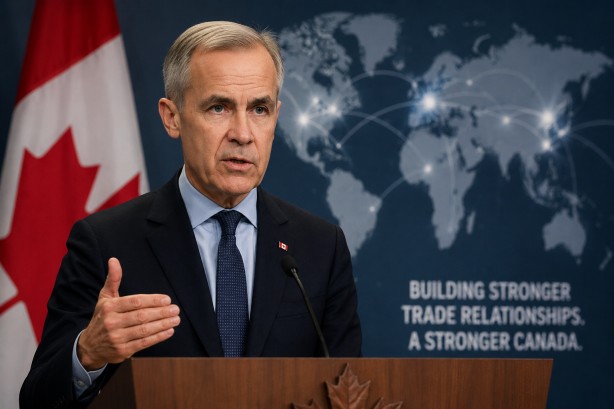
In a bid to redefine its role within the global landscape, Canada is signaling a strategic shift in its international relationships, especially concerning its southern neighbor, the United States. This change in stance has been articulated by Prime Minister Mark Carney in a series of recent public addresses, where he underscored the evolving dynamics of the world order. At the World Economic Forum in Davos, Carney drew attention to the fractures emerging in the global framework, urging nations to embrace stronger alliances grounded in common objectives, thereby minimizing reliance on any singular superpower.
Canada’s evolving foreign policy approach was further underscored when Carney declared the country’s withdrawal from ongoing trade talks with the United States. This decision comes on the heels of persistent disagreements over tariff implementations and other trade-related issues, reflecting a broader intent to recalibrate its economic engagements. The move is indicative of Canada’s strategy to expand its international partnerships and reduce economic dependence on the US, aiming to safeguard its sovereignty and national interests.
The longstanding economic interconnection between Canada and the United States has been a cornerstone of North American economic cooperation. Yet, in acknowledging these deep-rooted ties, Carney has been clear about Canada’s need to adapt to the shifting economic landscape. This adaptation involves fostering relationships with a diverse array of global partners, thereby fortifying Canada’s position on the international stage.
With these developments, Canada is charting a course to bolster its diplomatic and economic alliances beyond its traditional focus. The implications of this shift are significant, potentially altering the dynamics of North American economic collaboration. As Canada navigates this transition, it remains committed to ensuring that its national interests are prioritized in an increasingly multipolar world.