

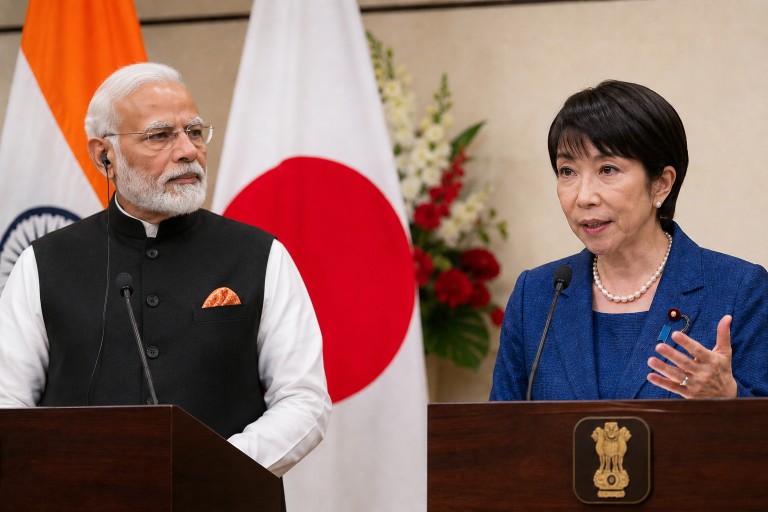
An error in translation led to a misunderstanding during a recent joint press conference between Japanese Prime Minister Sanae Takaichi and Indian Prime Minister Narendra Modi in New Delhi. The Japanese government clarified that Prime Minister Takaichi mistakenly stated that Modi had referred to her as his “beautiful sister.” The misinterpretation originated from a relay translation process that involved converting Modi’s Hindi remarks into English and subsequently into Japanese.
Officials explained that Modi’s original comment in Hindi referred to Takaichi as “my sister.” The official English translation rendered it as “my younger sister.” However, during the relay interpretation, the phrase was incorrectly translated to “beautiful sister” in Japanese. This error led Takaichi to believe the translation was accurate, and she repeated the phrase, mentioning that she and Modi intended to maintain their relationship in a sibling-like manner.
Japanese officials attributed the mistake to the inherent challenges of simultaneous relay interpretation, which can sometimes result in such inaccuracies. Despite the mix-up, they confirmed that the diplomatic relations between Japan and India remain unaffected by the incident. Furthermore, the Indian government has not raised any issues regarding the mistranslation, suggesting that both nations are keen to move past the incident without any diplomatic friction.
The incident underscores the complexities involved in international communications, especially during high-level diplomatic events where languages are translated multiple times. It highlights the importance of precision in translation to avoid misunderstandings between world leaders. The Japanese government continues to emphasize that the relationship with India remains strong and mutually respectful, with no lasting impact from this translation error.